Gold Discoveries and the Gold Industry
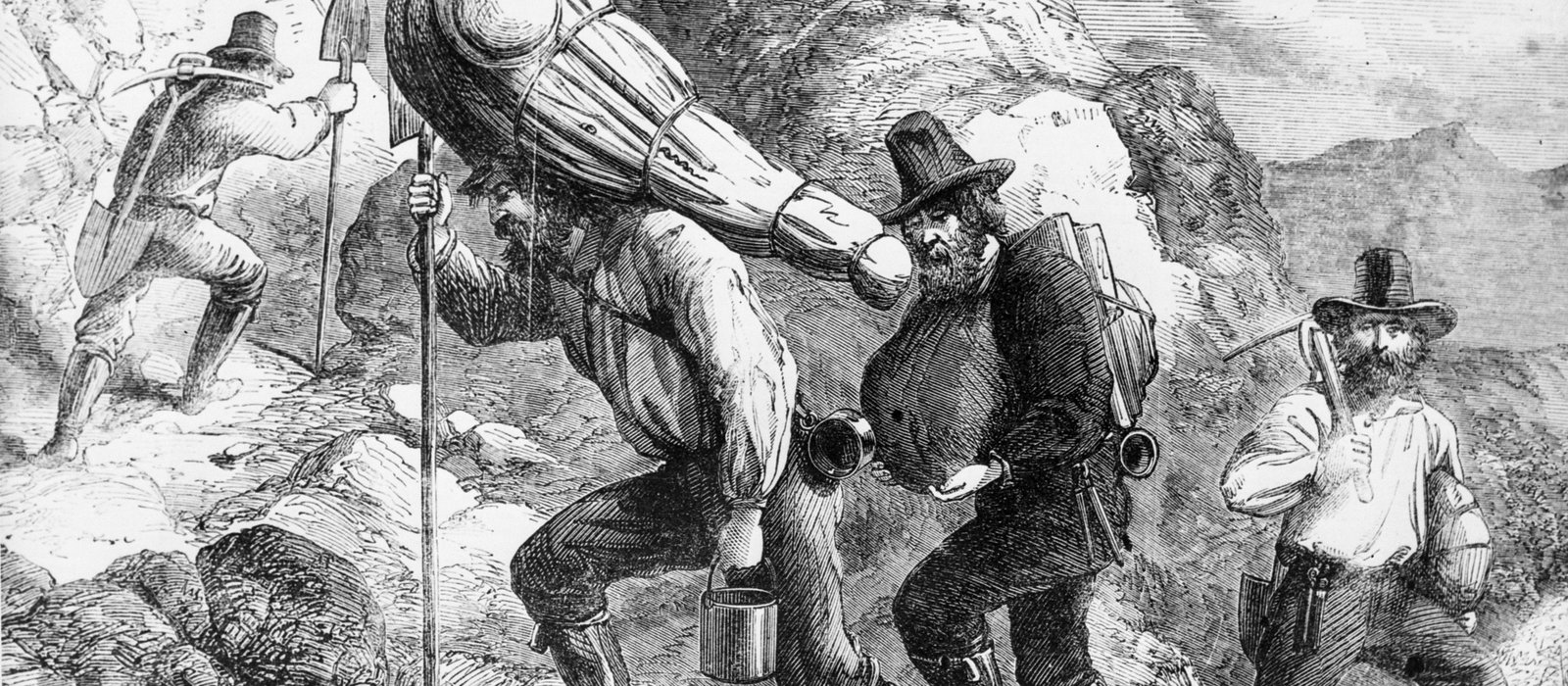
Gold was found here twice before its significance as a goldfield was realised.1 In February 1861 Rees’s builder, Thomas Wilson, took fine gold from the Lower Shotover, but Rees was angry, saying “gold diggings would ruin his enterprise”.1 In August 1862 Jack Tewa, another employee, showed Rees gold from the Arrow, which makes him the first known finder of gold in that river, though he did not follow it up.1 Credit for discovering the Arrow goldfield goes to Thomas Low and Peter Stewart (early in October), and for the Shotover to Thomas Arthur, who took out a claim and told the Warden.1
Vincent Pyke, the Goldfields Secretary, called what came next “The largest rush that ever occurred in Otago”.2 None of them could live off this country: groceries came up from Clyde and Rees’s run supplied the meat,3 and Pyke knew Rees to leave his bed at three in the morning when the flour boat came in.2 Until the site of the township was settled nobody could build permanently, so Queenstown became the largest canvas town in Otago,2 and a sheep station’s homestead turned into a thriving town.3 Of the Arrow in January 1863 the Otago Witness reported that “The night is one continual scene of fighting and screaming”.4
Up the Shotover, Māori Point was the upper river’s administrative centre from 1863.5 A hurricane stripped the canvas off its framed buildings in January 1865, and six months later its Bank of New Zealand burned down.5
Chinese diggers reached the Central Otago goldfields late in 1866 and were well established by 1870, and a settlement grew on the south bank of Bush Creek at Arrowtown.6 They took on ground Europeans had given up: at the Arrow the Mining Warden reported them testing a gorge “repeatedly tried and abandoned”.6 Some of the most vociferous early anti-Chinese agitation came out of this district.6
The methods of extracting the gold became more industrial and capital-intensive, moving from the riverbeds to hydraulic sluicing and underground tunnelling. A quartz reef found on the Arrow in 1864 was one of the first in New Zealand, and the Criterion company worked it until blue clay clogged the stampers and the mine closed in 1867.7 Up Skippers Creek a battery ran on hydro-electricity from March 1886, thirty-eight years before Queenstown had reticulated power.8 The Kawarau dam was an estimated three-month £30,000 project, finished in August 1926 for £100,000, which “simply did not work as a gold-mining venture”.9 Jack Reid, a boy in Arrowtown in the late 1920s, recalled that gold-mining had long since given way to farming.10
Two stories go further into it: the mine beyond Skippers that ran on its own electricity, and the settlement on Bush Creek.
Stories from this era
Sources
- 'Gold Finds within the present QLDC boundary up to 1 December 1862, information from George Griffiths as recorded by Ray O'Callaghan', Queenstown Courier No. 113, p. 26-30 (index)
- 'The Ubiquitous Vincent Pyke on the Otago Goldfields, compiled by Marion Borrell', Queenstown Courier No. 112, p. 10-11 (index)
- 'But You Can't Eat Gold, by Marion Borrell', Queenstown Courier No. 88, p. 13-15 (index)
- 'How Christianity Migrated to the Arrow, by Marion Borrell', Queenstown Courier No. 111, p. 20 (index)
- 'Maori Point at the Time of the Goodwins, gleanings by Marion Borrell', Queenstown Courier No. 108, p. 22 (index)
- 'The Excavation of a Small Chinese Mining Settlement and Store at Arrowtown, Central Otago, by Neville Ritchie', Queenstown Courier No. 34, p. 7-8 (index)
- 'Arrow Quartz Reef and the Criterion Mining Company, by Marion Borrell', Queenstown Courier No. 110, p. 21-22 (index)
- 'Pioneering electricity, and the Whakatipu Heritage Trust's restoration project, by Marion Borrell', Queenstown Courier No. 108, p. 23-24 (index)
- 'Kawarau Falls Dam and Bridge, by Raymond J. Clarkson, reprinted from Issue 56, 1996', Queenstown Courier No. 97, p. 23-26 (index)
- 'Arrowtown Remembered, Jack Reid reminisced in 2006', Queenstown Courier No. 97, p. 27 (index)