The Chinese settlement at Arrowtown
Who came, and why they lived here
Chinese gold diggers first appeared on the Central Otago goldfields in the latter part of 1866 and were well established by 1870,1 and from the 1870s they were part of Arrowtown.2 They came from Guangdong, encouraged by the government onto the Otago fields after many European miners left for other rushes. By choice and due to discrimination, the Chinese lived amongst themselves on the edges of the towns, which is why the settlement stood beside Bush Creek.2 The nucleus of it grew on the south bank, its siting possibly spurred by a Chinese store, which some Europeans viewed with concern.14
The ground the first rush had left
Like the European miners they were after alluvial gold from the Arrow and its tributaries.1 The Mining Warden reported in 1870 that at the Arrow they were “engaged in testing the gorge, which has been repeatedly tried and abandoned in consequence of the great difficulty in reaching bottom”.1 There was no compulsion to rework old claims, but the men in the village frequently did, content to work for steady returns rather than chase the illusive bonanza.2 About ten lived there through the warmer months while the rest mined at Macetown, Brackens Creek and Coronet Creek; the number rose in winter, when the village was a retreat from the cold.2 Many went home once they had made £100, the equivalent of twenty years’ wages in China; others were stranded without the fare, or had stayed until the relatives they would have returned to had died.2
Anti-Chinese feeling and legislation
No specific instances of violence towards the Arrowtown Chinese are known, but from the outset certain Europeans made it clear they were unwanted, understandably being European miners who saw them as competitors. Some of the most vociferous early anti-Chinese agitation emerged from the Whakatipu district.1 In 1871 the Arrow District Miners’ Association drew up a petition, circulated around the Otago goldfields and Dunedin, asking the Governor for a clause in the new Goldfields Act “forbidding the issue of Miners Rights to Chinese and place an effectual bar on their further influx”.1 The agitation continued, a Select Committee was set up in August 1871, and 1881 brought the first of a series of legislative restrictions on Chinese immigration.1
In the Queenstown cemetery twenty-three Chinese were buried at the western end.3 Some of them were later exhumed and shipped back to China where they wished to be buried.3
The village at its fullest
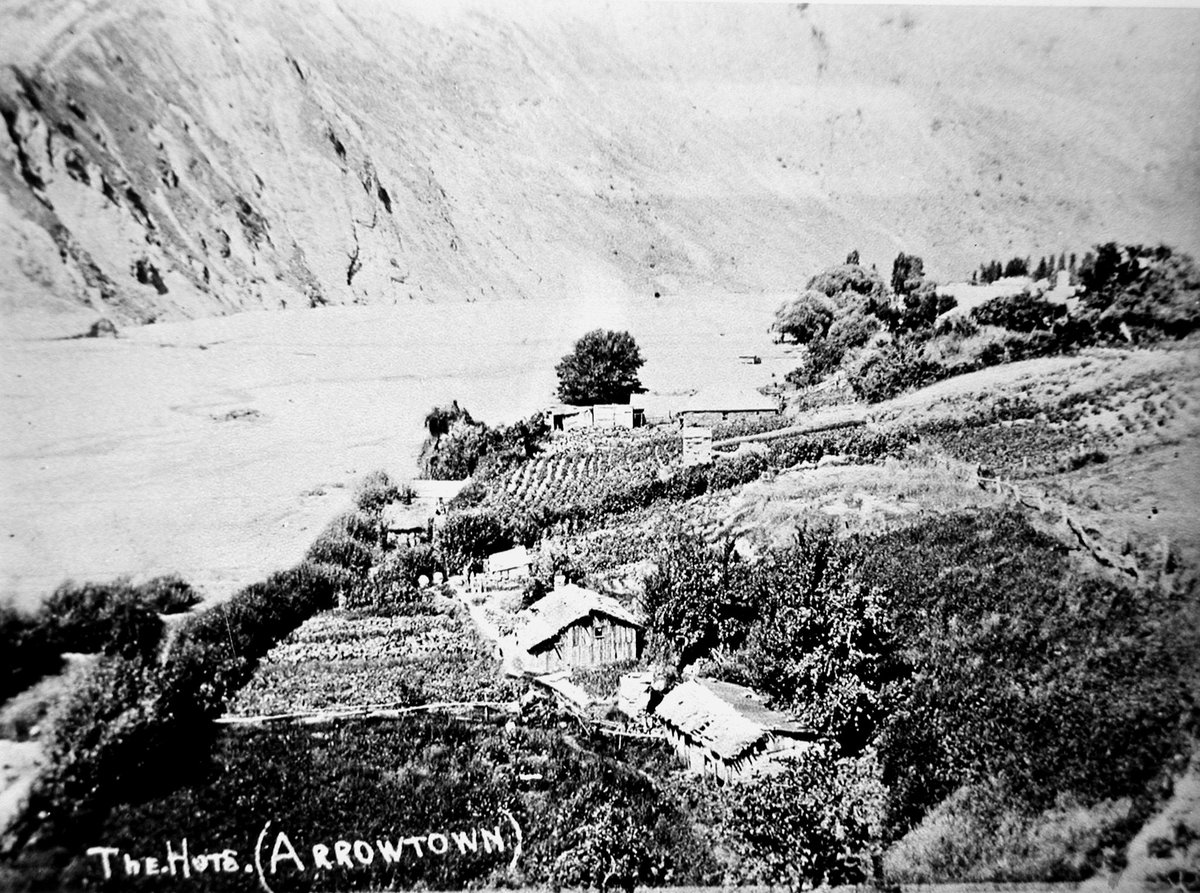
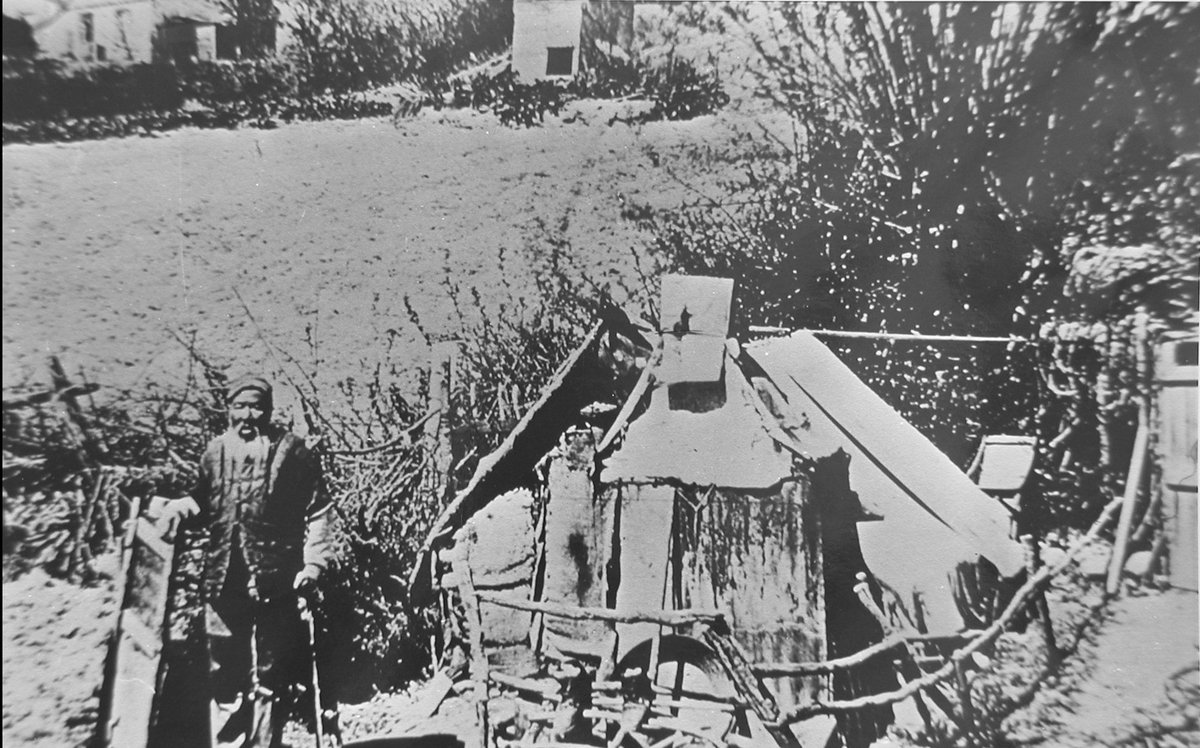
By 1885 the settlement was in two parts: an elongated scatter of about ten mud or stone huts along the foot of the terrace bordering Bush Creek, a social hall known locally as the Chinese long house, and two stores on the terrace above them.1 The stone store now known as Ah Lum’s was built in 1883 for the market gardener Wong Hop Lee, of schist rock with thatch on the roof.2 Wong Hop sold it to Loo Lee for £20 in 1907, and Ah Lum bought it from him after leasing it.2 Under Ah Lum it became a meeting place, an unofficial bank and an accommodation house for travellers and miners needing a bed.2 He had been a policeman in Canton, spoke English and was well educated, and wrote letters, translated business deals and handled government and mining matters for men who could not.2 The other store belonged to Ah Wak, who arrived from Zeng Cheng County in 1874 aged eighteen and mined at Macetown for twenty-two years before opening it; it burned down in about 1905, and its stacked-stone long drop is still there.2
Dwindling numbers
Elsewhere in the district, Wong Gong ran a store, market garden and orchard on the Shotover terrace near Skippers that is named after him, and is probably the only Chinese person with a geographical feature named for him in the Wakatipu; he died in 1909 aged 63.3 Ah Gum, who lived on Frankton Road and was known and respected by all, was the last remaining Chinese person in the area, and was buried in 1937 by the Salvation Army at a well-attended funeral.3
The Arrowtown Chinese village’s last resident died in the 1920s.2
In 1983 the archaeologist Neville Ritchie was contracted to investigate the settlement and its store, clearing, mapping and excavating over that November and December.1 The store was still standing and was to be restored as part of the site’s development.1 Arrowtown was one of about fifteen Chinese urban enclaves that grew up alongside Otago’s goldmining towns, and Ritchie wrote that it would be the sole surviving example of its type with substantial structural remains once Cromwell’s Chinatown went under Lake Dunstan in 1987.1
Ah Lum’s store still stands near the entrance to the village and is much-visited by people from China and all over the world.
More from Gold Discoveries and the Gold Industry
Sources
- 'The Excavation of a Small Chinese Mining Settlement and Store at Arrowtown, Central Otago, by Neville Ritchie', Queenstown Courier No. 34, p. 7-8 (index)
- 'The Arrowtown Chinese Settlement and Stores, by Denise Heckler', Queenstown Courier No. 92, p. 27-29 (index)
- 'Cemetery Walk, a walk around the notable graves in the Queenstown Cemetery', Queenstown Courier No. 72, p. 6-8 (index)
- 'Chinese Settlers in Central Otago, especially the Wakatipu Area, by Aimee MacMillan', Queenstown Courier No. 54, p. 13 (index)