
Electricity at Bullendale
A village at the end of a pack track
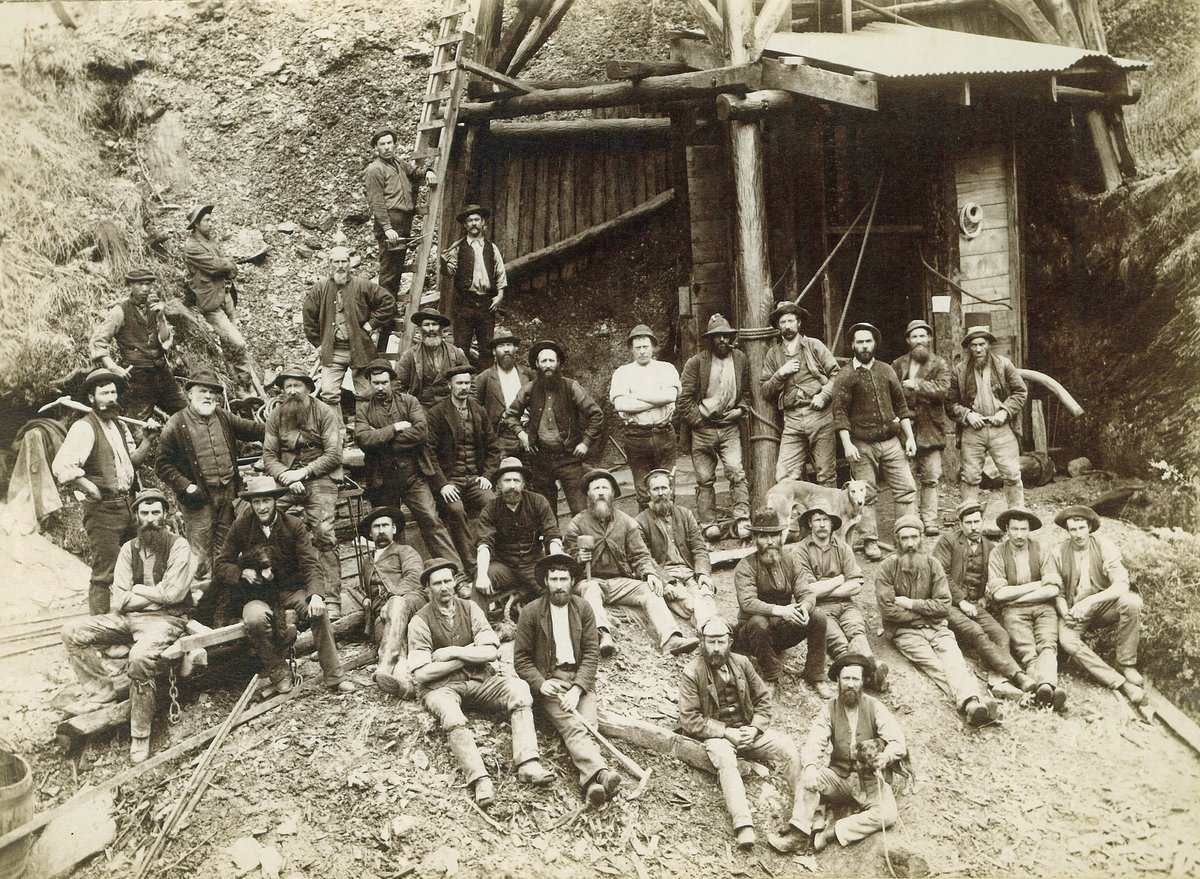
Bullendale sat up the Right Branch of Skippers Creek.1 It had no road then and has none now: the way in is a rough track six miles up from Skippers, along the creek and often in it, and everything came on packhorses.3 Falls of snow six feet deep were known and four feet was the average through the three months of winter, so children walked to school in boots with three one-inch metal spikes driven into the heels.3 Cotter’s Store was post and telegraph, grocer, butcher and draper in one building.3 Wages were £7 a fortnight.3 If a man was hurt or seriously ill the mine closed and he was carried out, sometimes the whole way to Frankton Hospital, with as many as 200 men taking part.3
Quartz, and the reason for a dynamo
Quartz had been found up the creek early. Andrew Southberg was one of the discoverers, in 1863, of the Scandinavian Reef near the head of the right branch, and in their second crushing his company took 500 ounces of gold from 400 tons of stone.2 In September 1878 the Great Flood came down Skippers Creek and swept away the Southbergs’ life at Bullendale, destroying both the house and the mine.2 The locals responded by fundraising for them: the employees at the Phoenix Company’s claim gave £41 and those at the New Nugget Company’s, £16.2 The family then based itself at Frankton and Andrew Southberg commuted each week.2 George Bullen owned the Phoenix quartz mine at what became Bullendale, with Fred Evans as his manager from 1868, and they had installed a 30-stamp crushing battery.1 In about 1884 a rich new source of rock was found at greater depth.1
The problem was power. The water supply for the waterwheel was not adequate to run all thirty stampers, and coal for steam was very expensive, so Evans proposed hydro-electricity and Bullen agreed.1 In 1885 Robert Fletcher and Walter Prince, electrical engineers from R. E. Fletcher & Co of Dunedin, were commissioned to design and install the plant for £2,200.1 The two three-ton dynamos and the other large items had to be dragged up the pack track from Skippers by bullocks and horses.1 Prince was thrown from his horse descending Long Gully and badly hurt his head, and Fletcher finished the installation.1 Generation began in March 1886, eight years after the world’s first hydroelectric scheme in Northumberland and five years after the first in the United States.1
What the dynamo powered
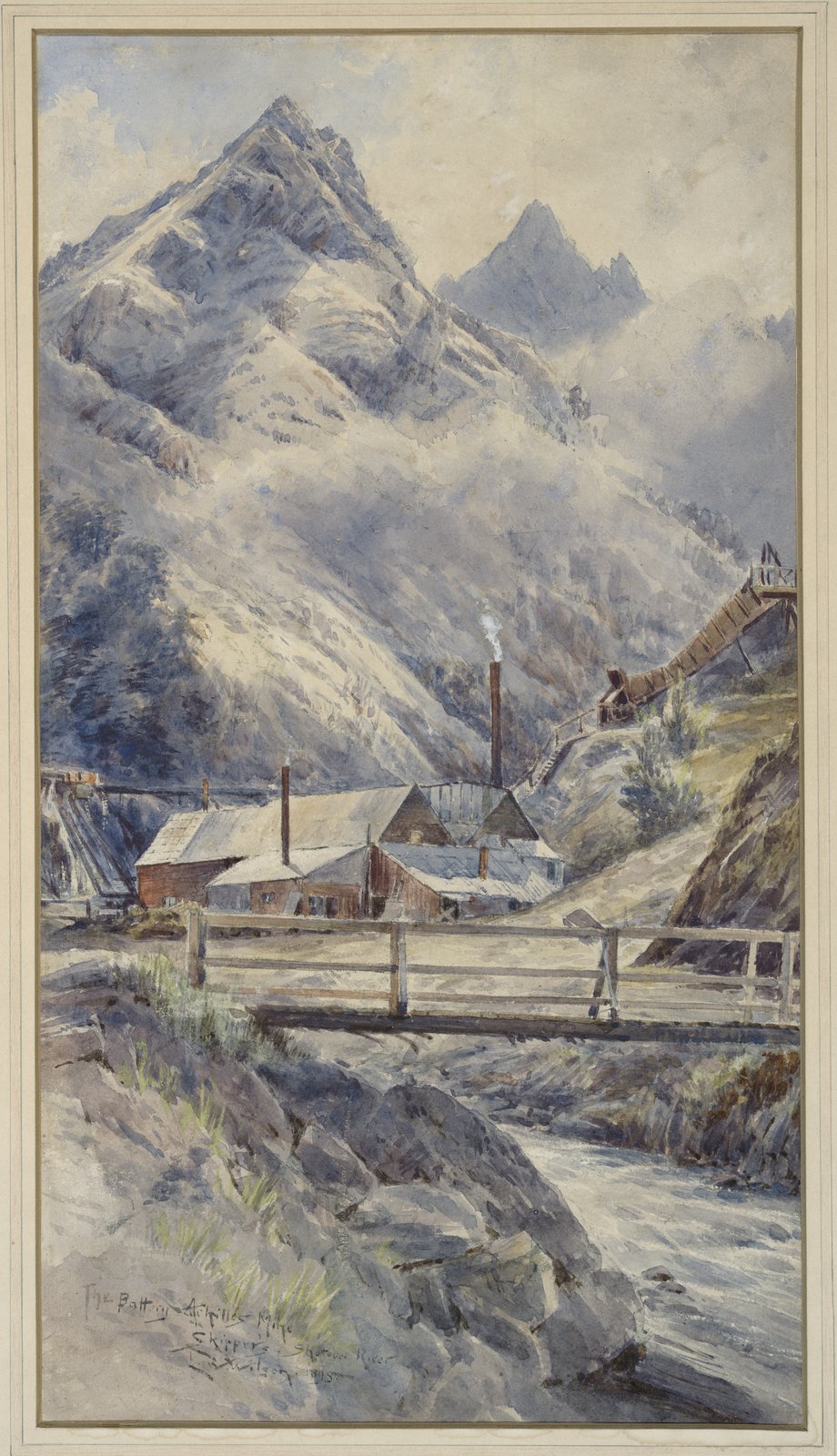
Water came a kilometre and a half by race from higher up the Left Branch, fell 60 metres down a bluff through two penstocks onto two double-bucket Pelton wheels, and drove two Brush arc dynamos whose combined output was about 80 horsepower at 2,000 volts.1 A double transmission line of number 8 copper wire ran three kilometres up 240 vertical metres over Southberg Spur and down to the mine.1 The battery went from twenty stampers to thirty; the current also worked the winch in the new main shaft and the rock breaker, ran lights underground and in the company’s offices, and lit the community hall and library, the school, some streetlights and some houses.1 Queenstown had no reticulated electricity for another thirty-eight years, until the One Mile Powerhouse opened.1 The Cromwell Argus of 13 April 1886 wrote that “This notable application of science as an aid to industrial pursuits is unique in New Zealand”.1
Disappointing gold reefs
The reefs of gold within the quartz rock were discontinuous, the rock was often of poor quality and therefore expensive to extract gold from.1 Returns fluctuated and expenses were very high in such a remote place.1 By the end of the century the workforce was down from as many as 200 in its heyday to 55, the mine was running at a loss, and the workers’ last-ditch offer to buy the operation was declined.1 Most families moved away. In Margaret Glennie’s account of her childhood her family left in 1901.3 Some mining continued but ceased in 1907.1
The dynamo site is now a Category 1 historic place and is considered nationally and internationally significant.1 Between early 2021 and May 2022 the Whakatipu Heritage Trust rebuilt the powerhouse as a replica, with the surviving machinery mounted in its exact positions, at a cost of $330,000, in a place with no vehicle access.1
In 2026 the Skippers Bridge was closed to all traffic, even walkers, due to earthquake risk. The only way to Bullendale now is by helicopter.
More from Gold Discoveries and the Gold Industry
Sources
- 'Pioneering electricity, and the Whakatipu Heritage Trust's restoration project, by Marion Borrell', Queenstown Courier No. 108, p. 23-28 (index)
- 'Helen Southberg née Craigie, sixty-four years from Bullendale goldmining to Frankton tourism, compiled by Marion Borrell', Queenstown Courier No. 114, p. 4-6 (index)
- 'Growing up at Bullendale 1890-1901, monologue as Margaret Glennie, People From Our Past 2019', Queenstown Courier No. 114, p. 11-14 (index)