Arrowtown at war, 1914 to 1918
A town of 308
The outbreak of war came as a terrible intrusion into the settled community of Arrowtown and surrounding districts.1 In the 1916 census Arrowtown borough had a population of 308.1 Buckingham Street had a general merchant, two hotels, a chemist, a butchery and bakery, a saddler, a tailor, a garage and a carpenter.1 The school roll that year was 55, with a convent school as well.1
Who went
The town had had a volunteer militia, the Arrow Mounted Rifles, since 1875, and four men from it volunteered promptly.1 Within weeks the Lake County Patriotic Fund had been set up with £200 of council money, and after that social life turned into fundraising.1
Conscription arrived with the Military Service Act in 1916.1 Nineteen Wakatipu men were selected in the first ballot, many of them carrying district surnames: Allan, Atley, Enright, Feehly, Green, Hunter, Jacobson, Jenkins, Jopp, Kennett, Lafranchi, Philip, Race, Ross, Summers, Wilson and Wishart.1 The war reached the pubs too: the Anti-Shouting Law of 1916 made it an offence to buy a mate a drink, and six o’clock closing came in during December 1917.1 The councils spent the later war years gravelling the roads from Queenstown to Arthurs Point and Arrowtown to Lake Hayes.1
The provisional roll published in the Lake Wakatip Mail in December 1917 listed 97 men of the whole Wakatipu district on active service or returned, with another 45 who had enlisted elsewhere.1 The death toll at that point was 30, and it rose further in 1918.1
Private John Smith of Arrowtown had his letter home printed in the Lake County Press on 4 January 1917. “I think we were the only Arrow boys who were in the thick of it,” he wrote, and of the big push: “We didn’t have a drink of tea for 4 days and never a wash or a shave for 10.”1 He was killed at Messines that June.1
Eighteen names
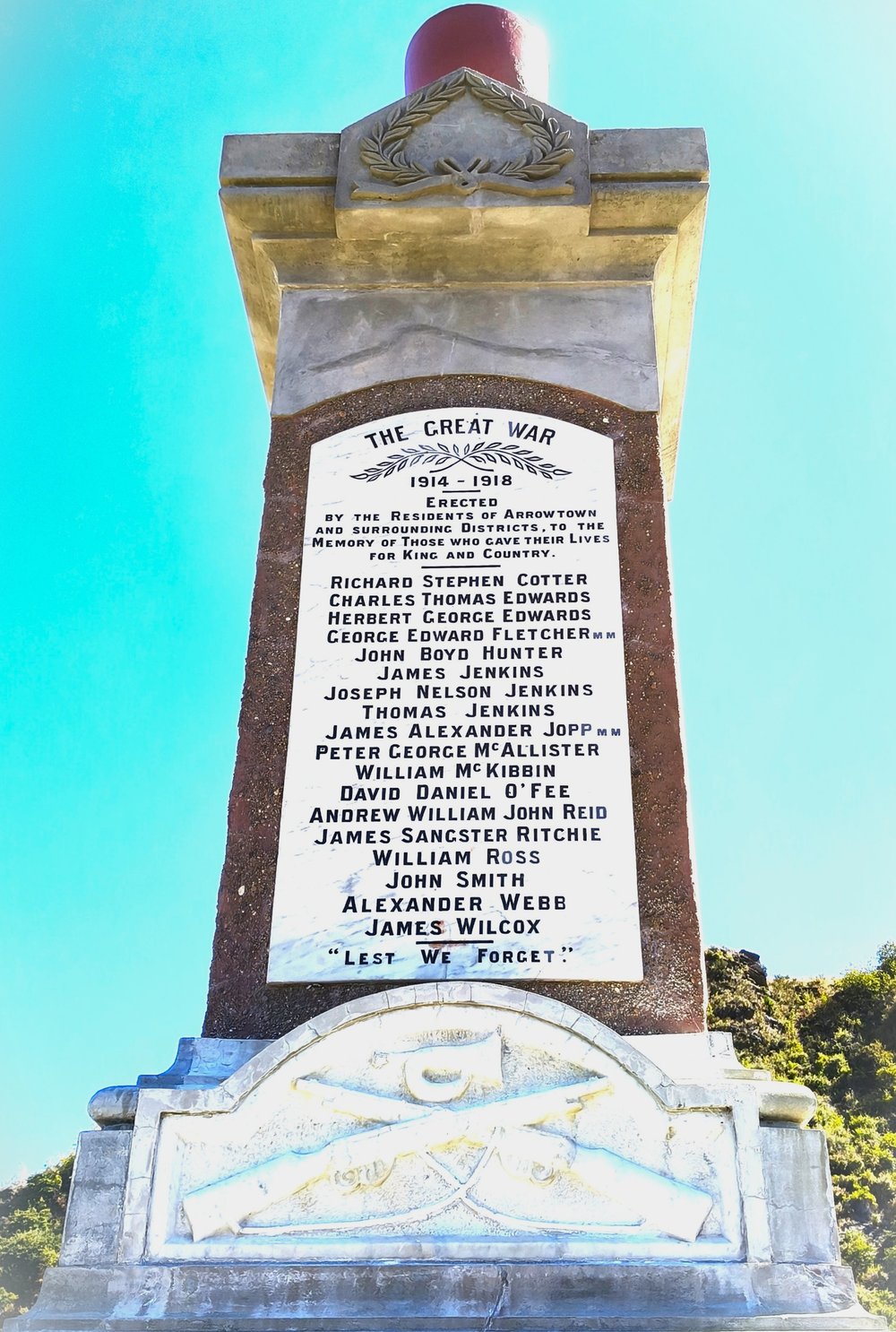
There are 18 casualties listed on the Arrowtown war memorial: three died in 1916, seven in 1917 and eight in 1918.1 They were not boys. The average age was 30 years and 2 months, and two were married.1 The Edwards family lost two sons within months of each other, Herbert on the Western Front in March 1918, aged 39, and Charles of a shell wound near Amiens in August, aged 34.12 William McKibbin of the Crown Terrace fought in Palestine and died of typhoid in October 1918, aged 24.2 Over the whole war 65 or more men from the Wakatipu district died, thought to be about one in three of those who served.1 After each death, all the churches acknowledged the man regardless of his religion.1
The people at home counted it too. One woman of Lake Hayes, who lost the man she had an understanding with, put it plainly: “So many men were killed that there were many World War 1 spinsters like me.”4 Those who stayed bore the consequences in damaged lives.
The influenza
News of the Armistice reached the district on 11 November 1918 and the celebrations went ahead as planned in both towns, although people were already sick.3 On 19 November the Lake Wakatip Mail reported that “there are few houses where there are not victims”.3 Both Queenstown schools closed indefinitely, no services were held in the Anglican or Presbyterian churches, and the billiard saloons, library, reading room, hotel bars, hairdressers and banks were all shut.3 The county and the two boroughs asked for a cordon around the district and were refused, but illness among the staff cut the trains from the south anyway, and the Earnslaw ran less often to Kingston and the head of the lake.3 At an Arrowtown meeting on whether the stores should close as well, one woman pointed out that people “could not do without food, but drink could be dispensed with”.3
Only three people died here, and all three had caught the disease elsewhere and travelled home.3 Most of the grief came from deaths elsewhere: 33 death notices for people with local connections appeared in the two newspapers.3 The Kinross family of Gibbston lost two adult daughters within four days, Jane at home and Mary in Dunedin Hospital.3 Bessie Kinross, who was about 20, recovered slowly: “it was eight months before I felt anything like well again.”3
Afterwards
The organised armistice celebration came a week late: a “Monster Procession” along Buckingham Street and Centennial Avenue to the Recreation Ground, with decorated wagons and cars, an ox roasted to a turn and the brass band.1 In 1923 the monument went up on Quarry Reserve, renamed Soldiers Hill, funded entirely by donations from the borough council, the RSA, sports and community organisations and individuals.1 Forty returned soldiers paraded at the unveiling and the school children with them, the same procession the district still walks on ANZAC Day.1
More from Growth & Community
Sources
- 'Arrowtown District during World War 1, by Denise Heckler', Queenstown Courier No. 114, p. 21-26 (index)
- 'Arrowtown's World War 1 Casualties, initiated, researched and written by Denise Heckler', Queenstown Courier No. 113, p. 4-7 (index)
- 'The 1918 'Spanish' Influenza in the Wakatipu, compiled by Marion Borrell', Queenstown Courier No. 101, p. 17-22 (index)
- 'Elizabeth Margaret White 1878-1961, Nurse Lizzie White, Lake Hayes, monologue by Marion Borrell', Queenstown Courier No. 115, p. 30 (index)