Changing Times
The Great Depression thinned the district rather than closing it.1 Fewer than 35 people in Queenstown were reckoned to be drawing the dole, because the work schemes soaked up most of the local unemployed and brought city men in as well.1 The county cut its rates by 44 per cent, half a dozen or so farmers gave up their farms to cover debts, and boys sold rabbit skins for pocket money.1
Three relief schemes carried the decade: the Kingston Road, the Arrow Irrigation Scheme and goldmining.1 The irrigation works had 192 people employed by the end of September 1926, and killed a man in the Arrow Gorge that May.2 Gold went the other way, its export value rising from £3.15s an ounce in 1931 to £8.45s in 1934.1
The road down the lake was approved in April 1927 and made by hand on purpose, to “swarm the project with men who would engage in laborious pick and wheelbarrow work”.3 The Government paid the men off in September 1929 and restarted the work in August 1934.3 The road opened on 4 April 1936, and crossed the Kawarau on the dam the gold company had built in 1926.3
Then the war. Roughly a hundred young men volunteered for the 23rd Battalion.4 Petrol was rationed from 1939, a Home Guard of twenty or thirty drilled in the town, a dugout beside the police station was used for air raid practice, and women were manpowered into the work left behind.4 The peace brought visitors: returning servicemen and their wives were given discounted travel passes, an estimated half of the arrivals afterwards were those couples, and Queenstown was “no longer a ‘quiet little village’”.4
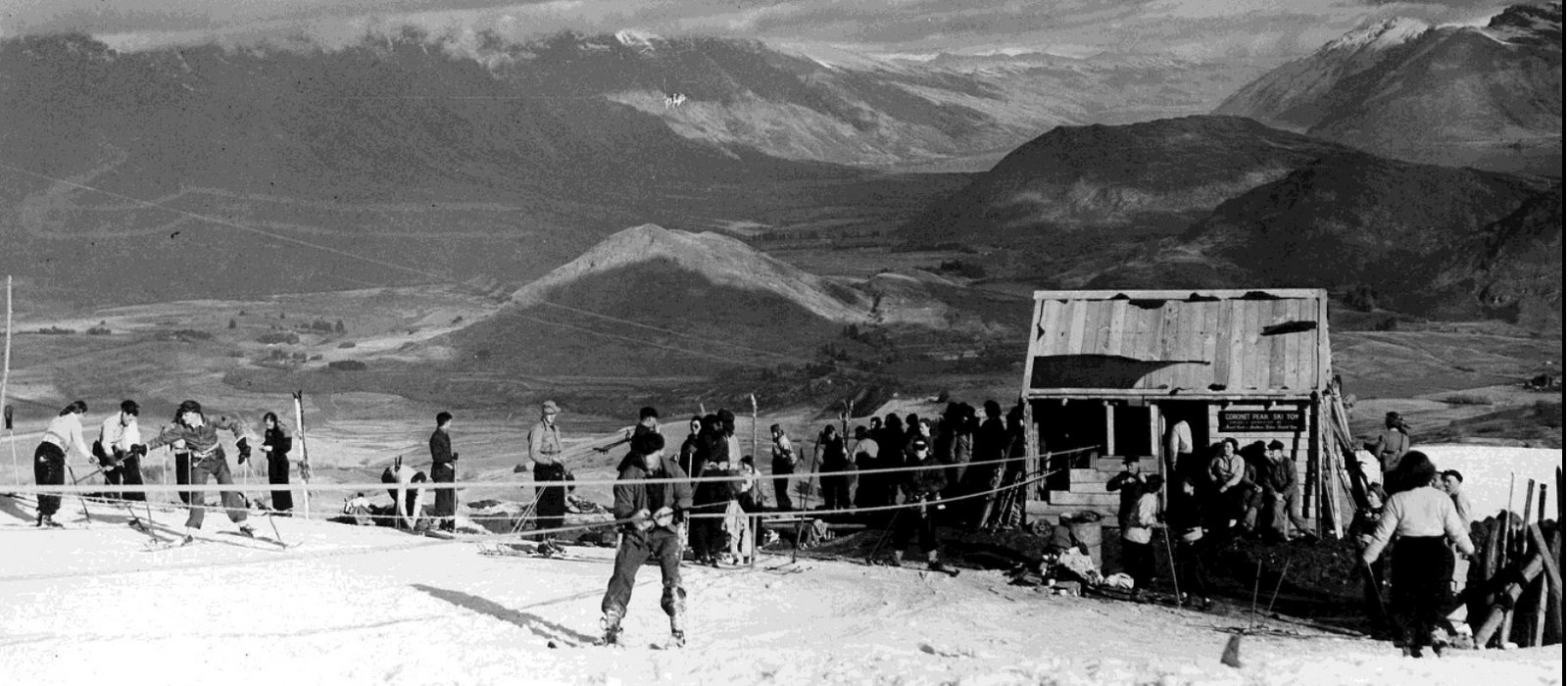
Winter became a tourist season. A rope tow went up on Coronet Peak in 1947, Paddy Strain told the Society, its engine borrowed out of a bus every winter and put back for the summer.5 Frankton racecourse was licensed as an aerodrome in 1935, the airline founded there that year was stopped by the war, and from 1964 larger aircraft could use the field.6
The lake shipping lost cargo custom. Thomas Davidson, engineer for the lake steamer service from 1930 to 1960, wrote that “now with the roads and bridges being built around the Lake her cargo carrying days are all but over”.7 The district became a holiday destination for Kiwis. Cribs (holiday cabins or baches) went up on private land from the 1930s. Queenstown Borough provided land for holiday parks in 1953,8 and by the 1960s visitors were “starting to arrive in buses”.9 In May 1965, with the Borough Council planning to replace the old stone library, thirty residents met and formed this Society.10
Stories from this era
Sources
- 'The Great Depression in the Wakatipu, 1929 to 1938, by Andrea King, written in 1989 when at Wakatipu High School', Queenstown Courier No. 105, p. 11-17 (index)
- 'The Arrow Irrigation Scheme, Origins and Continuation, by Marion Borrell', Queenstown Courier No. 105, p. 21 (index)
- 'Bluff, Sweat and Tears, The Story of the Kingston Road, by Danny Knudson', Queenstown Courier No. 84, p. 19-22 (index)
- 'The Effects of World War II on Queenstown, looking at before, during and after the war period 1939-45, by Denise MacMillan', Queenstown Courier No. 44, p. 3-9 (index)
- 'Memories of Early Skiing on Coronet Peak, by Paddy Strain', Queenstown Courier No. 91, p. 24 (index)
- 'Frankton Airport, The Racecourse that Grew Wings, by Marion Borrell', Queenstown Courier No. 102, p. 22-23 (index)
- 'The T.S.S. 'Earnslaw' of Lake Wakatipu, by Thos. Davidson', Queenstown Courier No. 11, p. 12-14 (index)
- 'Good-bye to the Last Cribs at Queenstown Camping Ground, photos by Evan Jenkins, words by Marion Borrell', Queenstown Courier No. 103, p. 21 (index)
- 'Childhood Holidays at Our Crib, 'Glengeddes', in the 1940s and 1950s, by Sue Simms nee Geddes', Queenstown Courier No. 103, p. 28 (index)
- 'Queenstown and District Historical Society History, by Irene Adamson', Queenstown Courier No. 74, p. 8-9 (index)