
The Kawarau Falls dam
Getting across
The outlet of the lake had been a working place long before it was a scheme. The Brunswick flour mill harnessed the water in 1867 and was decommissioned in 1904.1 Crossing was the problem. In 1916 an accident in a rowboat at night cost three farm workers their lives,1 and the punt that replaced the boats was rotten and dangerous from about 1908 and stopped running in about 1914.1 In 1911 Daniel McBride, the run-holder at Kawarau Falls Station, offered £100 towards a bridge, but the county baulked at finding half of the £3,200 it would cost.1 In 1922 it decided to build after all, started work, and stopped.1
The gold scheme
The idea behind the dam was older than the company: in 1867 a very low river exposed rich unworked gold below the falls.1 In 1922 the Kawarau Gold Mining Company was formed to build a large concrete dam designed to empty the riverbed.1 The estimate was £30,000 and five or six months.1 The company took a concession over the whole river, divided it into 128 quarter-mile claims and leased each for £1,000 plus 20 per cent of the gold recovered.1 Shares rose from one shilling to £2 in a matter of days.1
Locals objected at the Wardens Court, some because the falls were a tourist attraction and the islets would have to go, others because they doubted the gold was there; downstream bodies objected over navigation, hydro generation and flooding.1 The Public Works Department wanted a bridge, and eventually made it a condition of the licence that the dam carry a roadway the width of a standard bridge.1 The licence was granted in January 1924, and because the company met the costs, the department and the Lake County Council were relieved of any financial obligation to provide a bridge.1
Building it
On 22 November 1924 the Minister of Mines fired the first shot before about 2,000 people.1 The dam is ten concrete spillways, each sluice-gate imported from England and lowered onto its sill by a manual winch.1 The piers had to be bedded far underwater, so wing dams were built of sandbags, and three professional divers were employed, “strange, helmeted creatures who casually disappeared beneath the water”.1 There was a steam traction engine for the drills, two concrete mixers and several Fordson tractors; apart from those, “everything else was powered by pick and shovel, toil and sweat”.1
A workforce of 100 to 200 men assembled.1 The best account of them is an unsigned thirteen-page typescript by someone who was there, now at the Lakes District Museum. It describes a nomadic labouring class who stopped where the work was: “Men of classical education, the almost illiterate, fugitives from family responsibilities, hopeless alcoholics, the taciturn and the garrulous.”1 Many lived in a camp on the racecourse that later became the airfield, in huts of wooden frame and canvas.1 Two men drowned in the rapids, “probably not a bad record for the times before OSH set the safety regulations”.1 The job had been expected to take three months and took 21.1
The opening
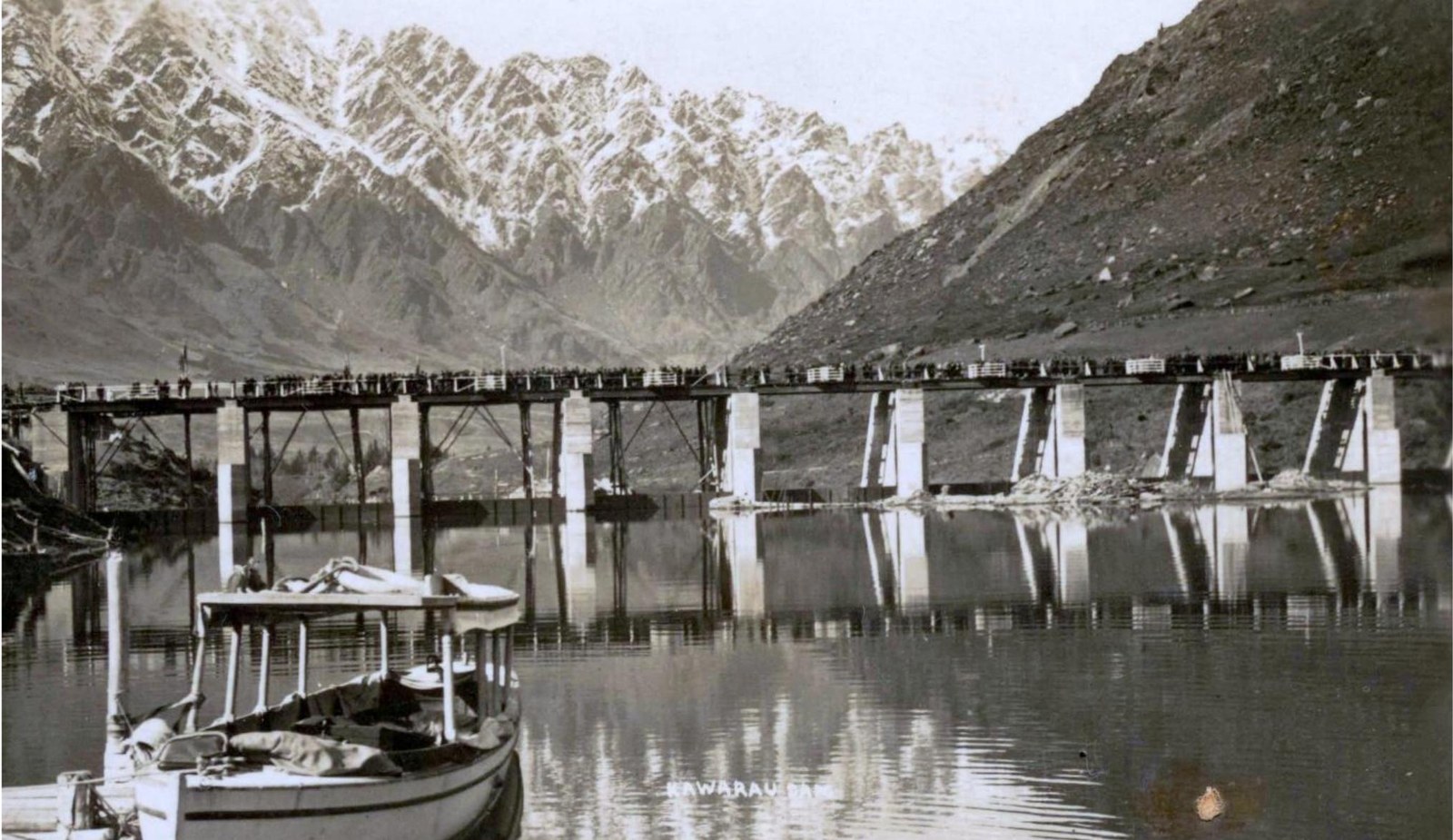
The official opening was held in August 1926, as soon as the gates could be operated and with much still to do.1 A crowd of 2,000 came, with hundreds of motor cars and several launches.1 People travelled from England, Sydney and Auckland for it, and the speeches praised the engineering skill that had accomplished “a great national work”.1 The Auckland Star of 30 August asked its readers: “Will Kawarau’s banks and bed be another Klondike?”1
What came of it
“As a mining investment, the dam was a complete failure with little gold won.”1 The gates held the lake back, but the water level fell only until it matched the Shotover delta, leaving a large backwater, and there were rock bars and old sluicing debris in the bed as well.1 More than £100,000 had been spent and there was no money left to build the second dam, on the Shotover, that the full plan had always needed.1 “In 1932 the Kawarau Gold Mining Company went into liquidation, ironically because of too much water remaining in the river.”1
The structure itself was another matter: in damming the outlet of the lake, which is what it was built to do, it worked.1 “Until 1936 the bridge led mainly to Kawarau Falls Station.”1
More from Growth & Community
Sources
- 'Centenary of the Kawarau Falls Dam Bridge (1926), compiled by Marion Borrell', Queenstown Courier No. 115, p. 5-15 (index)