The first tourists
The novelist
The town knew a verdict was coming. The Lake Wakatip Mail told its readers that “Such a distinguished tourist as Mr Trollope must be looked upon as a good authority”, and waited.1 Anthony Trollope came by coach from Invercargill, with a night at an inn, then Kingston and a steamer.1 The rain set in as they crossed, and he wrote that they “huddled down into a little cabin” and consoled themselves that they were crossing the most beautiful of the New Zealand lakes without seeing it.1
The next day the party went up the lake in the Jane Williams, the temperature at freezing point all day.1 He did not know, he wrote, “that lake scenery can be finer than that of the upper ten miles of Wakatip”, and the whole district around was, “or rather will be in coming days, a country known for its magnificent scenery”.1 Of the town itself, then about 2000 people, he was cooler: after crossing the world, “you have not at all succeeded in getting away from England”.1
The ritual
Eleven years later an anonymous visitor wrote it all down. Queenstown “reminds one of nowhere in particular”, he decided, though with a church tower and an olive grove “it might pass for a little Italian port”.2
The compulsory activity was climbing Ben Lomond. “All tourists are impressed with the idea that they must ascend Ben Lomond”, he wrote, and hired horses to the saddle, considerably more than half way.2 Having got to the top they scampered down and narrated their experiences in the visitors’ book at Eichardt’s, a record begun by Sir George Grey in which “the fastest time on record” was continually noted: 1.58, 1.53, 1.50.2
Three times a week a boat did the sixty miles to the head of the lake and back in a day, leaving at seven with a square meal served on board.3 He went by the Mountaineer, whose teetotal owner he abused in print for carrying no brandy.3 The boat called first at Glenorchy, then crossed the Dart to Kinloch, where he found “a wharf, a little hotel beside a deep gully, three cottages on a slope” and the dark birch forest behind.3 Watching the local children come down to the wharf, he asked whether they would become guides for future tourists.3
The houses built for the trade
Eichardt’s was the town’s travel centre before it was anything else. The coach companies used it as their depot, and with the start of the Cobb and Co services visitors such as Sir George Grey were delivered to the door.4 Albert Eichardt had bought the place, then the Queens Arms, in 1866, when it was a fairly primitive building.5 He knew that goldfield hotels sprouted and died,4 and in 1872 the wooden building was replaced with one of stone and concrete.5 After he died in 1882 his widow Julia carried on the business. She commissioned the Invercargill architect F.W. Burwell for an extension in which the ladies’ parlour held two pianos, and she installed electric lighting through the hotel in October 1886.5
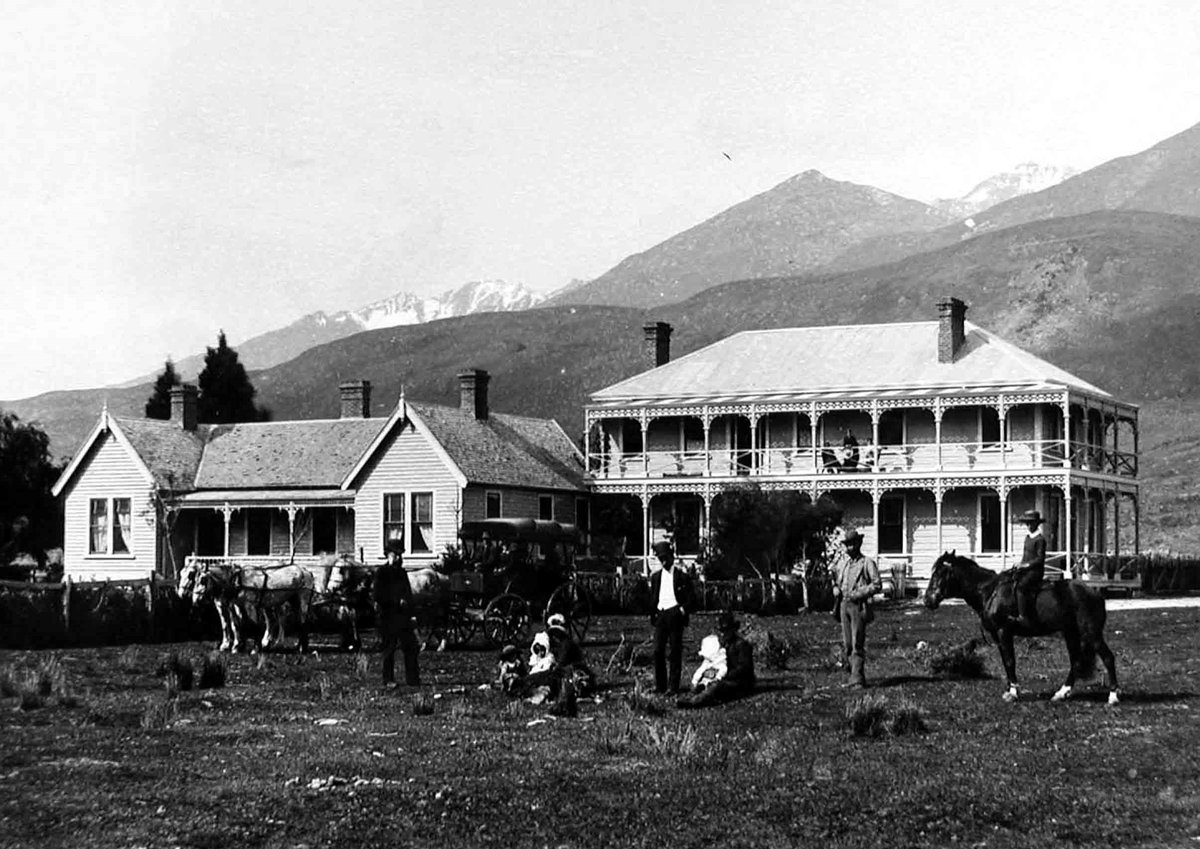
The head of the lake had its own houses. Birley’s Mount Earnslaw Hotel at Glenorchy was built as a single storey in 1880 to Burwell’s design and gained a two-storey section in 1885; the publican’s son Harry was a highly regarded mountain guide, and on 16 March 1890 he was the first person to reach the summit of Mount Earnslaw.6 At Kinloch, Richard Bryant had built a house in 1868 and used a front room for a bar, never serving enough alcohol to make a man drunk and always closing at 10pm.7 He cut tracks and planted gardens for his visitors, and after the January 1887 fire destroyed the beech forest around Kinloch he started horse treks to the Routeburn Valley.7
Climbing for the sake of it
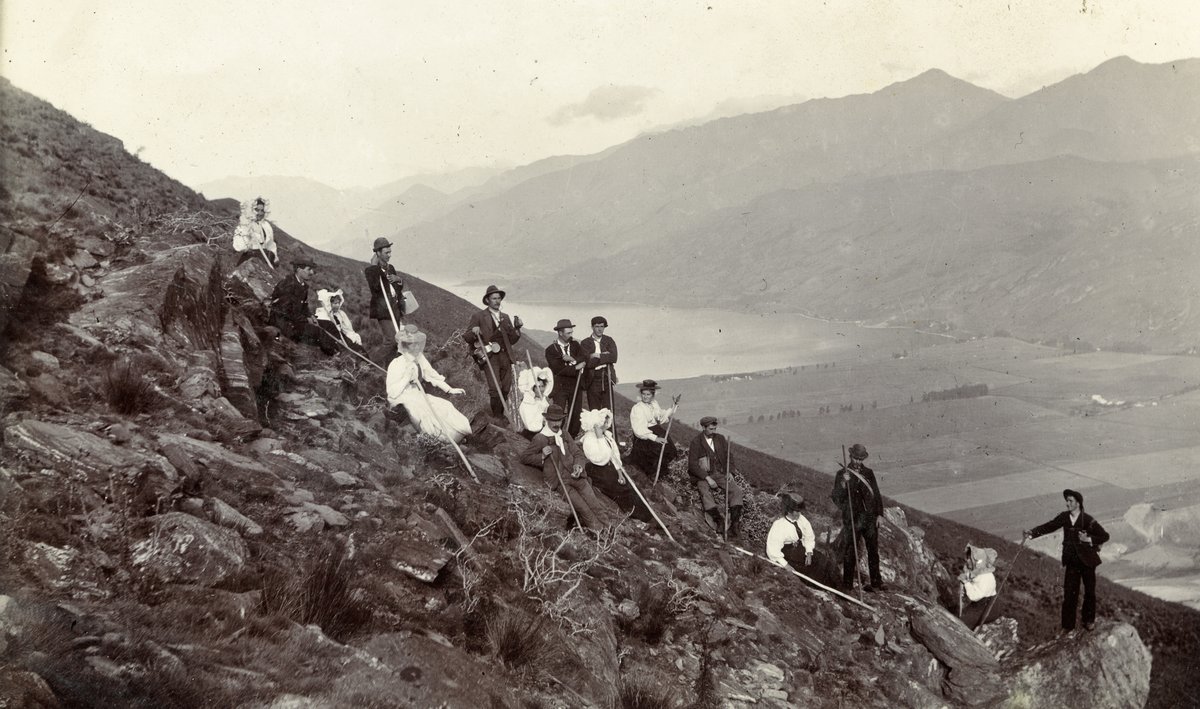
A government geologist, T. R. Hackett, reached the summit of the Remarkables in 1864, and for him it would have been work.8 For the party photographed on the flank of the range in 1899 it was recreation: they had set off from Arrowtown the day before, and climbed in shirt and tie, in sunbonnet and full-length dress.8
The count
In 1903 the Industries and Commerce Department asked the Queenstown Borough Council for a return of the accommodation available in the town.9 Five hotels were listed. Eichardt’s was the largest, 45 rooms for 60 guests at ten shillings a day; the Mountaineer took the most guests of any house in town, 75; and five boarding houses took another 85 between them.9 The Mountaineer’s advertisements told “Families and Tourists visiting the Lake District” that they would meet with every accommodation, and that it was “within a convenient distance of the Pier”.9
More from Transport and Early Tourism
Sources
- 'Celebrity English Writer Visited Queenstown: Anthony Trollope 1872, by Marion Borrell', Queenstown Courier No. 97, p. 9-10 (index)
- 'A Visitor Looks at Queenstown, August 3rd 1883', Queenstown Courier No. 12, p. 17 (index)
- 'A Visitor Looks at Queenstown, August 3rd 1883, part 2', Queenstown Courier No. 13, p. 3-4 (index)
- 'Guests and Travel at Eichardts, by Raymond R. Timmins', Queenstown Courier No. 63, p. 18-19 (index)
- 'Eichardts Hotel', Queenstown Courier No. 35, p. 13 (index)
- 'Mount Earnslaw Hotel, by Pat Paulin', Queenstown Courier No. 94, p. 13 (index)
- 'Kinloch: Accommodation and Wharf, by Neville Bryant', Queenstown Courier No. 90, p. 30 (index)
- 'Climbing the Remarkables, 1899, by Anthony Mason', Queenstown Courier No. 95, p. 32-34 (index)
- 'The Growth of Tourism, by Alan De La Mare', Queenstown Courier No. 78, p. 12-13 (index)