The Whakatipu steamers
The timber men who needed a ship
Access to Queenstown from the east was confined to mere tracks, so most goods came by small ships on the lake, carried by a ragtag collection of small steamers whose service and comfort left much to be desired.1 The men who fixed that were in timber. J. W. Robertson and Co had formed a syndicate to put a sawmill on the Greenstone River at the head of the lake, the nearest source of standing timber,1 and opened it in August 1863.2 In 1868 they decided to build a paddle steamer to bring the timber down.2
The Antrim
She was designed by John Turner, an English naval architect living in the district, and built at the company’s sawmill near Kinloch by three shipwrights, one of them Thomas Luckie, trained in Dundee.3 Her timber, red beech, tōtara and matai, came down a two and a half mile wooden tramway off the lower slopes of Mount Bonpland.3 Construction started in March 1868, she was launched on 28 October3 by Ellen McBride, a sister of one of the owners,2 and first steamed on New Year’s Day 1869.3 She was 82 feet long and made 8 knots.1
On that first run she showered her passengers with sparks that ruined many dresses and suits, so a balloon stack was fitted to the funnel to catch them; it stayed until she was converted to coal in 1894.3 She earned good money for her owners with the capacity to carry as many as 800 bags of grain along with the firewood her boiler needed.3 Coming in to a wharf her captain had to stand on top of the paddles and shout directions to the engineer.2
Luckie remembered loading her at the Greenstone with posts, rails, firewood and the sawn timber left over from her building, which went to make the company’s wharf at Queenstown.3 He rebuilt her twice, and at his suggestion she was sheathed above the waterline in zinc, which he reckoned made her last twice as long.3
Two rivals
Her success did not pass unnoticed. A rival partnership had the Jane Williams, later the Ben Lomond, built in Dunedin of Lowmoor iron, the components carted to Queenstown and the ship put together on the waterfront to be launched on 10 February 1872; she took 100 passengers and 25 tons of cargo.1 She had no side keelsons and a tendency to roll.4 In May 1881 she left Kingston in the evening with passengers and cargo into a fierce nor’wester.4 Her cargo shifted in the hold, and after hours in danger of sinking she limped back in the morning.4
The railway reaching Kingston in 1878 promised more business, particularly in the tourist trade, and prompted some local businessmen into ship owning, an activity they had no experience of.1 They were run-holders, merchants, hotel-keepers and a solicitor, from Nokomai, Kingston, Arrowtown and Queenstown.5 Their vessel, the Mountaineer, was assembled in Dunedin, dismantled and reassembled at Kingston,1 where shipwrights, boilermakers, carpenters and painters worked from 5am to 8pm six days a week until she was launched, festooned with cabbage trees, on 11 February 1879.5 The Mountaineer cost about £7,800 and was much bigger than either of the others.1 Her saloon was panelled in birds-eye maple and offset with red velvet upholstery, with a ladies’ room forward.5
The work
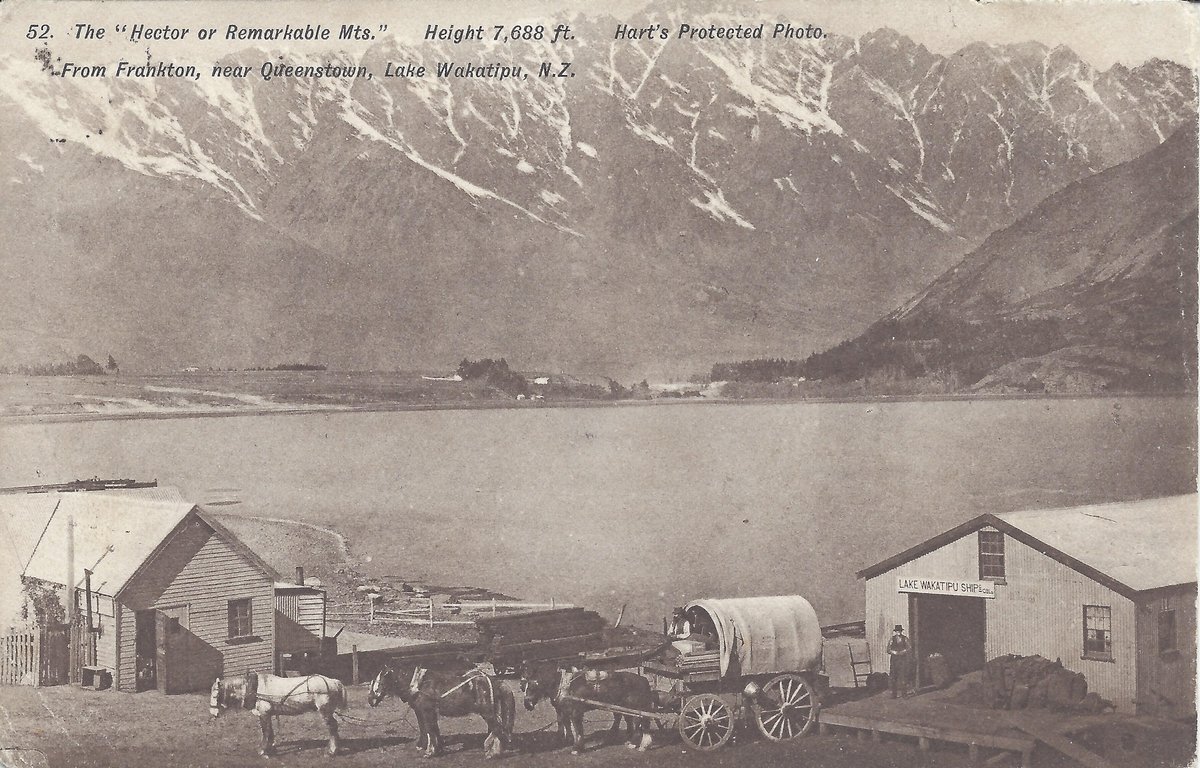
What made the boats pay was the train. The Mountaineer’s most successful times were when her movements coincided with the train services at Kingston, the main artery to and from the district; farm produce, mining materials, tourists, mail, timber and supplies were her stock in trade.5 Over five days in May 1905 she and the Antrim ferried 6,000 sheep from Glenorchy to Mount Nicholas.5 The wharf built at Frankton in 1878 handled wool and grain going away while timber, coal and machinery were landed.6
The lake could still stop them. At 5am on 11 June 1883 the Mountaineer left for Kingston in a heavy snowstorm and ran aground on a beach at Collins Bay, cutting in almost to her paddles, and the Antrim hauled her off five days later.5
NZ Railways on the lake
Competition ate the profits until the two companies amalgamated in 1885,1 to form the Lake Wakatipu Shipping Co. However, after some years the community complained: sailings that did not suit the rail timetable, a night at Kingston for anyone going on to Dunedin, and coal that came over 120 miles by rail for 8/11d a ton then cost 10 shillings a ton for the lake.1 In 1901 the government commissioned a report from J. Faris of the Railways Department. It was unfavourable, and recommended that if radical changes were not forthcoming the government should take the company over.1 The New Zealand Railways Department formally took over shipping operations on Lake Whakatipu in 1902 and acquired the Lake Wakatipu Shipping Co’s vessels.7
This acquisition eventually led the government department to commission the iconic steamship, the TSS Earnslaw, which began its service under the railway network in 1912.8 After this there was much less work for the Antrim, and she became a reserve vessel.3 The boat the timber men had built at their own mill was now the spare one.
More from Transport and Early Tourism
Sources
- 'Lake Shipping and Daniel McBride, by Alan De La Mare', Queenstown Courier No. 67, p. 9-18 (index)
- 'Thomas Hicks: From Farm Boy to Miner, Captain and Businessman, compiled by Marion Borrell', Queenstown Courier No. 111, p. 7 (index)
- 'The Paddle Steamer P.S. Antrim, 1868-1920, an excerpt from All Aboard by R. J. Meyer', Queenstown Courier No. 111, p. 11-13 (index)
- 'Storm on the Wakatipu, contributed by A. De La Mare', Queenstown Courier No. 28, p. 18 (index)
- 'The Paddle Steamer Mountaineer, by Pat Paulin', Queenstown Courier No. 89, p. 25-26 (index)
- 'Frankton Wharf, 1898, by Marion Borrell', Queenstown Courier No. 91, p. 28 (index)
- 'Arcadia Guest-house, Paradise and Joseph Cyprian Fenn, by Clive Geary', Queenstown Courier No. 103, p. 30 (index)
- 'Former Engineer Recalls Thirty Years on the Earnslaw, by Thomas Davidson, in Salute to the TSS Earnslaw', Queenstown Courier No. 88, p. 23-24 (index)