Saving the old stone library
Thirty people at a public meeting
On 27 May 1965 a public meeting was held in Queenstown, and from that meeting the Queenstown and District Historical Society was formed.2 It was convened by Fred Barnes and attracted 30 Arrowtown and Queenstown residents “keen to try to preserve the district’s historic relics”.1
The new society was not universally welcome. Some at the meeting expressed concern that its formation “might detract from the objectives of the Lakes District Museum”.1 Barnes answered that the aims were “preserving old records, buildings, bridges and early gold-mining sites together with fostering a spirit among children for the same”,1 along with one that has never got easier, “endeavouring to achieve the blending in of new buildings with the rest of the town where possible”.1 The officers elected that night were Dr Bill Anderson as chairman, Fred Barnes as secretary and Hugh Miller as treasurer.1 Dr Anderson was an exceptional citizen as, besides being the sole GP, he was also many times the Mayor and was chairman of many organisations, St John among them. The Courier’s tribute records fifteen years as Mayor of Queenstown, ten as deputy-mayor and the chair of the St John sub-centre.8 Danny Knudson’s history of the district’s doctors has him the sole medical practitioner and superintendent of the Wakatipu Hospital from 1923 to 1950,11 and the magazine’s pages show him making frequent trips to the Kingston road camps in the 1930s9 and attending births out at Lake Hayes.10
Within months, the new-born society quickly found itself responding to danger.
A glass and chromium building
The Queenstown Borough Council made the decision to replace the Library.4 The building was genuinely run down: inside, Marygold Miller wrote, it “became hopelessly out of date, and was so neglected as to be almost sordid”.4 What was planned for the corner was “A glass and chromium building”,5 and the stone bridges and the Trees of Justice were on the same list.6
The district’s 1962 centenary of the gold discoveries had been celebrated with enthusiasm about its historic identity,1 which is why Marion Borrell later found the Council’s 1965 decision strange.7
The Society’s first campaign began, led largely by Marygold and Hugh Miller.
Proving a building sound
Alarmed citizens formed a second group, the Friends of the Old Stone Library.4 “The first thing was to prove that the library was structurally sound and there was no urgent need to demolish it.”4 For a society only months old that meant finding an architect, a solicitor and an engineer.1 Out of it grew a nation-wide campaign to save the building and the Wellingtonia trees beside it.1
“The newspapers from all over New Zealand took up the cry for preservation, of their own free will”,4 and during the parliamentary elections week the fight “rated the front page of the Otago Daily Times three days running”.4 A telegram arrived from the Māori people in Dunedin, and Marygold Miller remembered a haka on the site.46 The Historic Places Trust said it was prepared to donate £500.4
The Library Fighting Fund statement put the net loss on the battle at just over £26, and against it the Society entered its gain: “One significant step towards preservation of worthwhile stone buildings”.4
The casting vote, and the count
At a special meeting of the Council on 15 November 1966 the Mayor dashed all hopes, using his casting vote in favour of demolition.4 The demolition engineer waited at Momona Airport in Dunedin with the motors of his private plane warmed up, for word that the Council had finally agreed.4
In the end, the impasse was resolved by a referendum.1 It was set for Saturday 11 February 1967, with the Society granted the right to be a referee at the count: 175 voted for destruction and 343 for preservation.4 Marygold Miller’s 1971 account ends in three words: “THE BUILDING WOULD REMAIN”.4
“The conservationists won the battle and the Council was thrown out at the next election”, she wrote, and Warren Cooper, “having come out on the side of conservation, was elected Mayor”.5
On 1 May 1971 the Malaghan Wing to the library was opened, and the President, Ian Daniel, thanked the members whose efforts had saved it.2 Mayor Warren Cooper told them “it is most important to ensure that the more interesting links with the past are preserved”.2
What is still on the corner
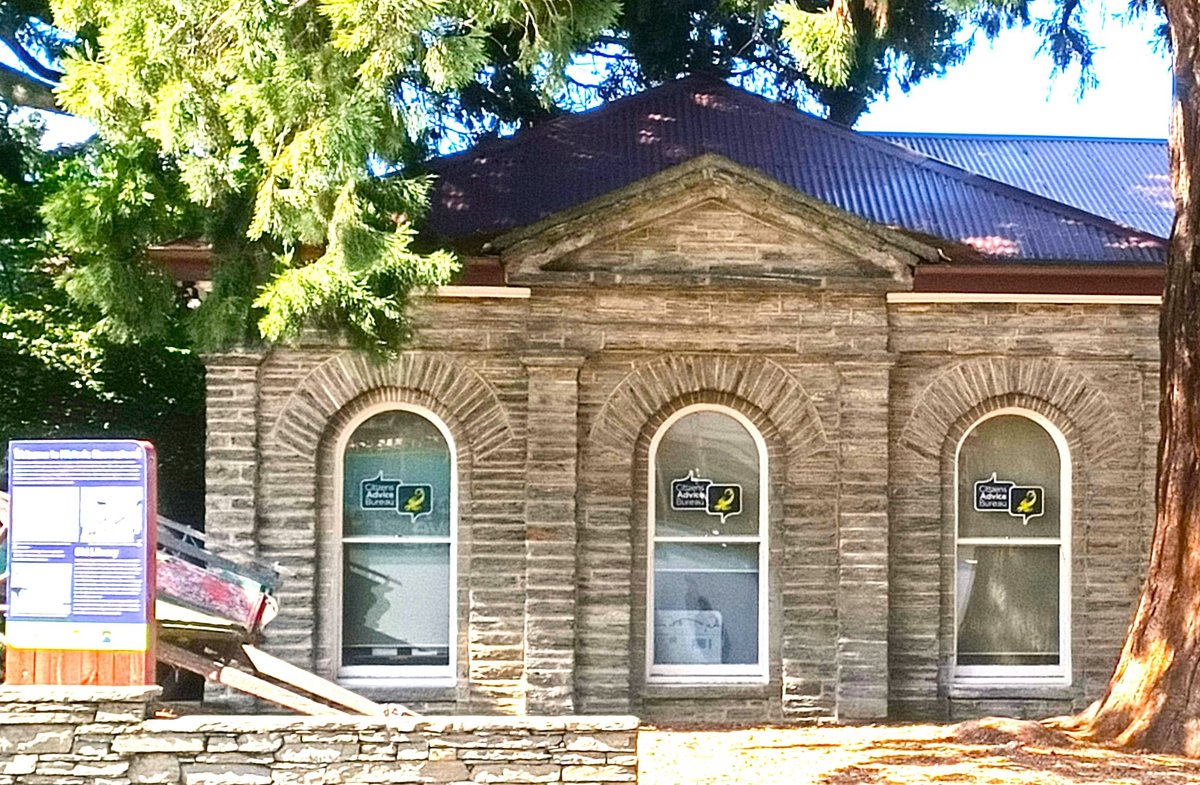
The well-preserved former library (seen here in 2023) still serves the community as the Citizens Advice Bureau.3
More from The Society's History
Sources
- 'Queenstown and District Historical Society History, by Irene Adamson', Queenstown Courier No. 74, p. 8-10 (index)
- 'Editorial: What Direction?', Queenstown Courier No. 66, p. 1-2 (index)
- 'Marygold Miller, A Fighter For Queenstown's Heritage', Queenstown Courier No. 85, p. 24 (index)
- 'The Battle for the Queenstown Library 1965-1971, by Marygold Miller, reprinted from Courier Issue 6, May 1971', Queenstown Courier No. 85, p. 25-28 (index)
- 'Fighting, From the Start, by Marygold Miller with Margaret Templeton', Queenstown Courier No. 78, p. 8 (index)
- 'Snippets: Historic Battles', Queenstown Courier No. 73, p. 22 (index)
- 'Queenstown & District Historical Society and Heritage Protection, Observations by Marion Borrell, 2023', Queenstown Courier No. 110, p. 32 (index)
- 'The Late Dr. William A. Anderson', Queenstown Courier No. 21, p. 1 (index)
- 'The Great Depression in the Wakatipu, 1929 to 1938, by Andrea King, written in 1989 when at Wakatipu High School', Queenstown Courier No. 105, p. 15 (index)
- 'Elizabeth Margaret White 1878-1961, Nurse Lizzie White, Lake Hayes, monologue by Marion Borrell', Queenstown Courier No. 115, p. 31 (index)
- 'Call the Doctor! Early Medical Practice in the Wakatipu, by Danny Knudson', Queenstown Courier No. 89, p. 19 (index)