
The Post Office appeal
What the Society could not afford in 2001
In April 2001 the Society published an open letter asking for “an urgent review of the council’s planning process, particularly the consent granted for the four storey Forester’s Lodge development”, which “is central to Queenstown’s only intact Heritage Precinct”.1 The Society, the Historic Places Trust and a local petition had all sought public notification.1 A Judicial Review was beyond the Society’s financial capability, so it petitioned the Ministers of Environment and Local Government and the Prime Minister instead.1
The building on the corner
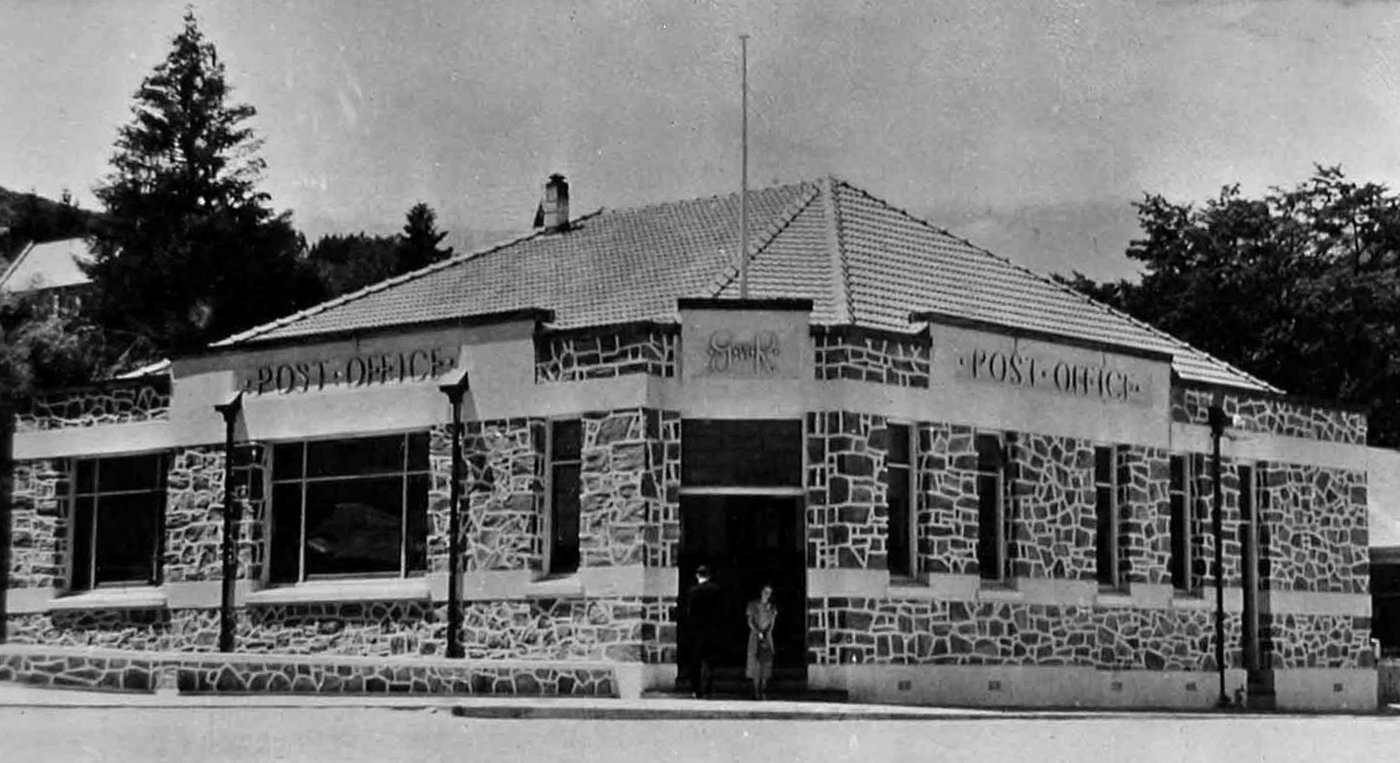
The building “was built in 1938, designed by notable Invercargill architect E. R. Wilson, and merited an award from the Institute of Architects that year”.3 Wilson, commissioned to use local materials, took timber from the head of the lake and put local stone in the cladding.3 His stonemasons found “a rare and giant rock of green and hard glacial greywacke in the lake near the end of the Gardens”, and the white pointing came from Stewart Island sand.3 All of it was recorded on a plaque inside, which “went missing when the building was gutted and the roof modified in the late 1970’s”.3
Why it was exposed
“Most Queenstown citizens thought the Post Office was safe when owned by the Government.”2 It was the fourth post office on the site, and was not in the District Plan as a heritage building, nor registered with the Historic Places Trust.2 Ngāi Tahu then purchased the site from the Crown as part of the Treaty settlement, together with the police station and the court house, and the redevelopment planned for it would demolish the Pig & Whistle, the post office and the Telecom building; the courthouse was sacrosanct.2
The committee asked the Trust to register the building, but the development complied with the District Plan and registration would not necessarily prevent demolition.2 On 20 April the Council issued Ngāi Tahu a certificate of compliance permitting demolition.2 The Society then asked for the courthouse area to be protected and the Post Office saved, with a fallback of pushing “for the history of the site to be recorded if demolition is inevitable”.2
Five days
In 2002 the Society took an appeal to the Environment Court,10 against the Council’s decision “to allow two buildings in the Ngai Tahu Property Group’s development to encroach on to the Courthouse historic precinct”.4 The case had to be run “if we are to have any faith in the district plan as a protective mechanism for our heritage”, the President wrote.4 The Society engaged Tony Oxnevad as counsel, the Christchurch architect Peter Beaven as expert witness, and its own committee member Elizabeth Macdonald, a planner, to present the planning case.4
The hearing commenced on 29 March 2004 and after five days was adjourned with the evidence incomplete.5 Then the money went wrong. The Society’s counsel departed overseas, a replacement was briefed late, and costs to date passed $42,000, some $20,000 more than the grant.5 “The Society is not able to meet these costs.”5 It was left to Elizabeth Macdonald “to do the job a lawyer should have been doing”.6
The judgment, and the bill
On 25 September 2004 the Environment Court disallowed the appeal.8 Judge Sheppard confirmed that the effect on the precinct was “minor”.7 Proceedings had cost a total of $41,256, met in part by a Ministry for the Environment grant of $22,500.7 Ngāi Tahu then applied to the Court for an unspecified “reasonable contribution” towards half of their $144,000 total costs.7 The Society’s cash assets at 30 September 2004 were $21,998, and the auditor recorded that a costs award beyond the Society’s ability to pay would leave it technically insolvent.8
“The year was dominated by the hundreds of hours of time invested in the Court proceedings, and the negative results have had a devastating effect”, the President wrote.7 The Society had based its appeal on the District Plan and the Historic Places Trust protection of the precinct, and the Trust’s own sign-off of the proposals worked against it at the final call; the judge was not critical of the Society’s evidence or presentation.7 Macdonald had given her planning advice free.7 The committee appealed to members and friends, the membership made a tremendous response, and the Society’s finances were restored, for the time being.7
What it bought
The editorial, taking the President’s words, refused to call it wasted: “it was a hard-fought and prolonged attempt to state a point of principle, and safeguard one of the few remaining shards of heritage in Queenstown”.6 Two years later the president reported that “The heavy strain of the Ngai Tahu proceedings has brought the Society an improved profile”, with some developers and designers now consulting Society representatives early in their planning.9 Since then the Society has preferred to engage with owners and use the processes available without initiating legal action.10
More from The Society's History
Sources
- 'An Open Letter to the Lakes District Council and its Rate Payers, by Malcolm Boote', Queenstown Courier No. 66, p. 3 (index)
- 'Queenstown Post Office, by Malcolm Boote', Queenstown Courier No. 68, p. 23-24 (index)
- 'Queenstown Post Office, by Mike Lynch', Queenstown Courier No. 68, p. 25 (index)
- 'Appeal to the Environment Court, by Malcolm Boote', Queenstown Courier No. 70, p. 3-4 (index)
- 'Appeal to the Environment Court, by Malcolm Boote', Queenstown Courier No. 72, p. 4 (index)
- 'Editorial: A Lost Case, But Not a Lost Cause, by Mike Lynch', Queenstown Courier No. 73, p. 3 (index)
- 'Queenstown & District Historical Society President's Report, November 2004, by Malcolm Boote', Queenstown Courier No. 73, p. 4-5 (index)
- 'Environment Court Appeal Account, audited by D. Warrington BCom CA', Queenstown Courier No. 73, p. 23 (index)
- 'Queenstown & District Historical Society President's Report 2006, by Brian R Bayley', Queenstown Courier No. 77, p. 3 (index)
- 'Queenstown & District Historical Society and Heritage Protection, Observations by Marion Borrell, 2023', Queenstown Courier No. 110, p. 33 (index)