
Hakitekura
Hakitekura was the daughter of the Kāti Māmoe chief Tuwiriroa, and she was born at Tāhuna, the flat land of Queenstown Bay where the town centre stands now.1
The crossing
From a spur on Ben Lomond, Hakitekura used to watch the young women of Tāhuna competing against one another in the water, each trying to outswim the rest.1 Then she asked her father for a kauati, a firestick, and some dry raupō.1 She wrapped both in flax to keep them dry, and left in the darkness to swim the lake.1
Her course was set by the dawn coming up on the tops of Cecil and Walter Peaks, and that is where the names of those peaks come from: Kā Kamu o Hakitekura, the twinklings seen by Hakitekura.1
When the people of Tāhuna woke, they saw the fire she had lit at her landing place on the far side.1 Her father remembered his daughter asking for the kauati and the raupō; a search found her missing, and a waka was sent to fetch her.1
The names she left
Three more places around the lake carry her name.1 Refuge Point, where she came ashore and lit her fire, is Te Ahi-o-Hakitekura, the fire of Hakitekura.1 Ben Lomond from which she had watched the races is Te Taumata-o-Hakitekura, the resting place of Hakitekura.1 The Kelvin Heights Peninsula is Te Nuku-o-Hakitekura, the expanse of Hakitekura.1
Stand on the Queenstown waterfront and you are at Tāhuna, surrounded by places which bear her name as well as their English ones.
What the Society has put up for her
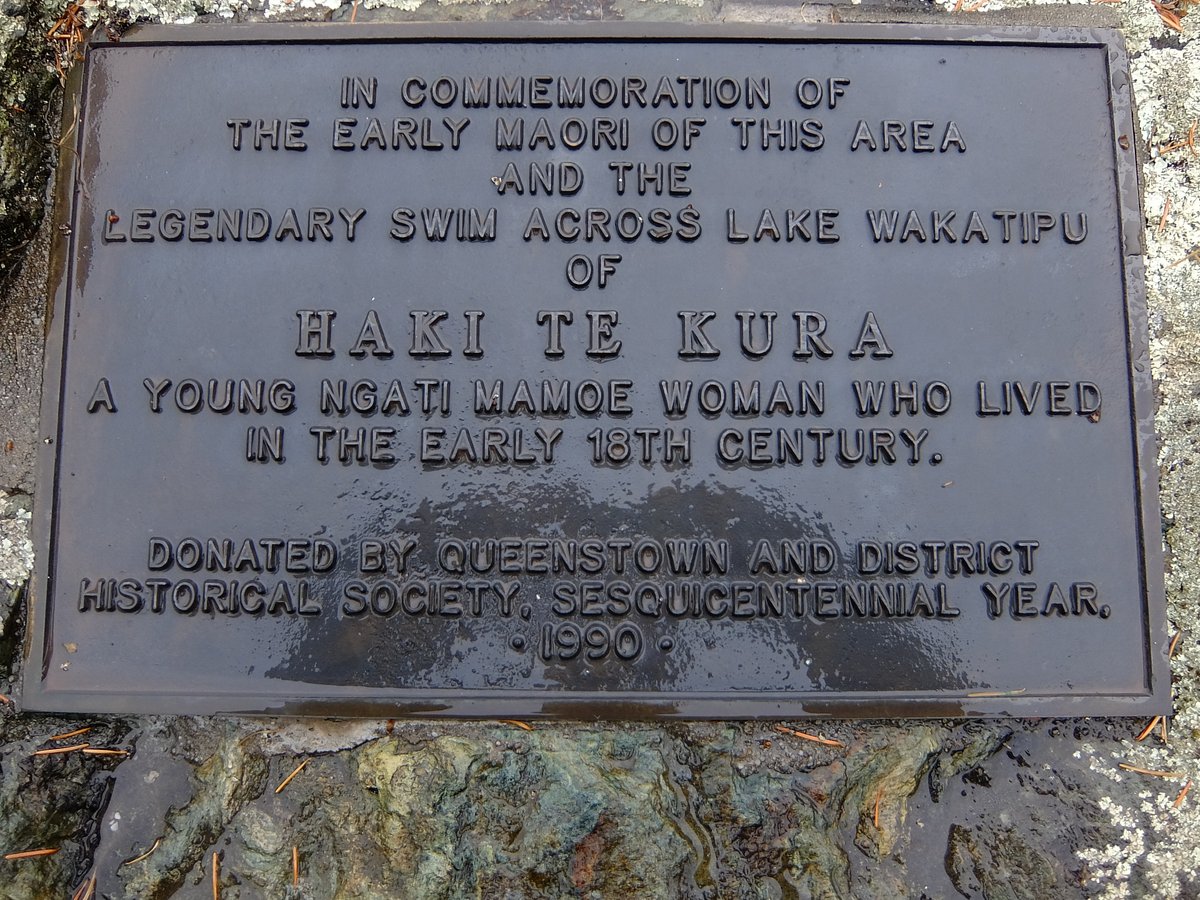
The plaque is on a rock near the Scott Memorial, in the Queenstown Gardens2 where the small settlement of Te Karoro stood.1 Her swimming feat is also commemorated in the heart of the town: sculptures and panels line a walkway, downstream of the Ballarat Street bridge.2
More from Māori History & First Colonists
Sources
- 'Māori Placenames in the Wakatipu, by Pauline Lawrence', Queenstown Courier No. 104, p. 21-22 (index)
- 'Three Memorials in the Queenstown Gardens - Scott, Hakitekura, Rees, by Marion Borrell', Queenstown Courier No. 91, p. 31-34 (index)