Rees, von Tunzelmann and the first runs
Country applied for sight unseen
In November 1859 William Gilbert Rees applied for depasturing licences in the still-unsurveyed district around Whakatipu, before he had been anywhere near it.1
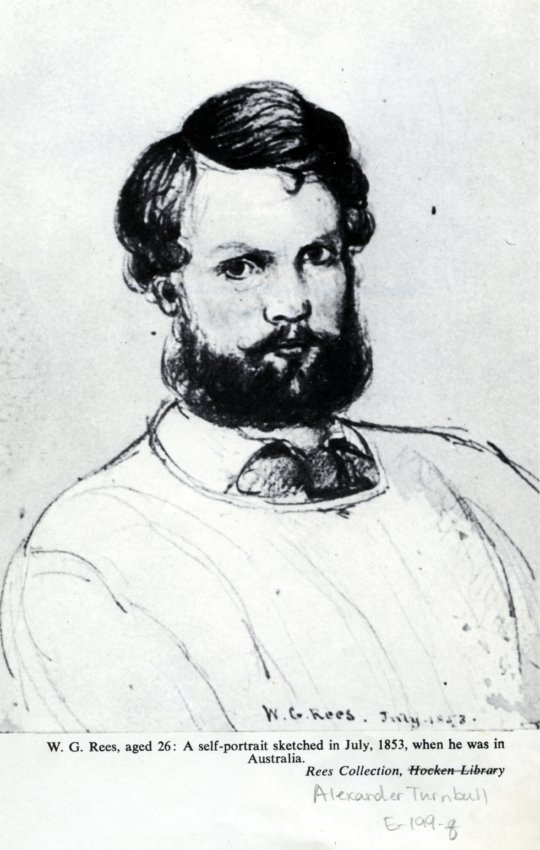
In January 1860 he set out to see what he had asked for, with a few companions including his wife’s brother-in-law, Nicholas von Tunzelmann.1 By von Tunzelmann’s own account, written in 1899,7 they held “a grand council of war” and all but Rees made up their minds to give it up.2 They went on, up a good leading spur that Rees named then and there for the crown-like shape of its summit: the Crown Range.2 They reached the future site of Queenstown in February.3 The reports they brought back to Dunedin in mid-March gave readers of the Otago Witness their first real knowledge of the interior.1
The words the Society put on its Rees memorial, taken from his own account of what he and von Tunzelmann pushed through, are: “Speargrass often more than three feet high and masses of matagouri constantly impeded us.”4 The memorial is in the Queenstown Gardens, and anybody can walk up and read that line off it.4
Two runs, one lake
They divided it between them. Rees applied for land on the eastern border of the lake; von Tunzelmann took up Run 350, Fernhill, 50,000 acres, on the west.3 At the southern end, the run then called Bucurochi passed to Captain Howell in 1860, and he renamed it Fairlight.5 It has been Fairlight ever since.
Stocking a run at that distance was brutal arithmetic. Of the 2,000 sheep von Tunzelmann’s partner Pharazyn had shipped from Melbourne, only 600 were landed, and about 60 more were lost when the survivors rushed for the salt water on reaching the shore.6 His men then refused to stay with him, and he was left alone on the run for five weeks.6 The run itself did not last. In the monologue the Society drew from his 1899 pension letter, agents sold it two years before the lease expired and left the family penniless.7 He was for a time the railway station-master at Kingston, and he died at Frankton in 1900.7
The home station
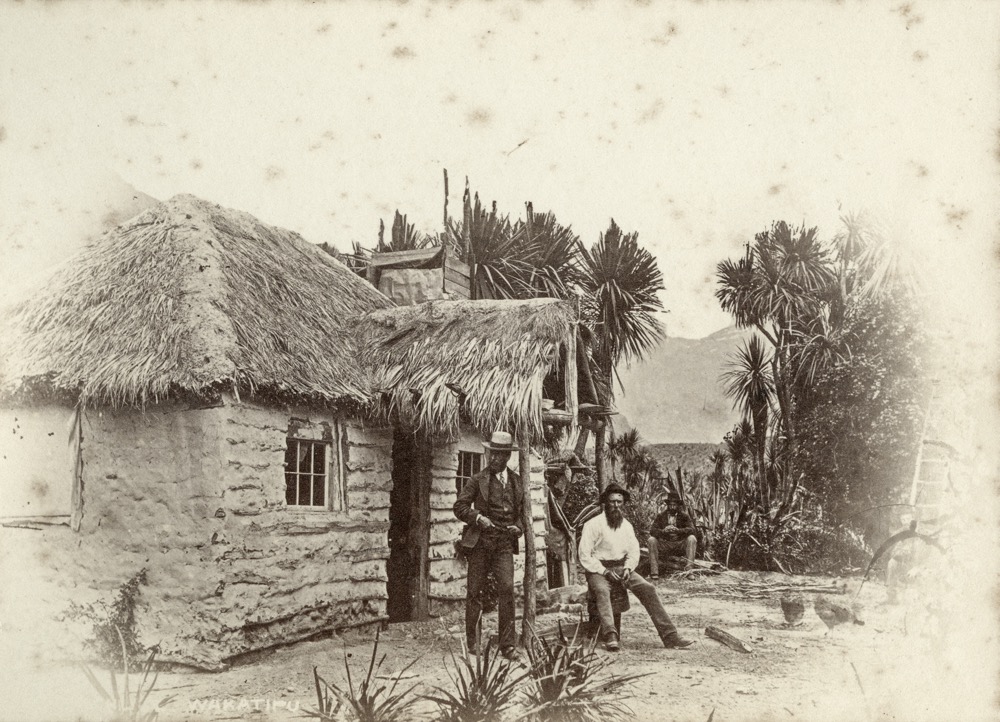
Alfred Duncan reached the home station in December 1860 and left the earliest description of it. The buildings were a “futter”, a storeroom built on top of posts, and a long narrow hut of three rooms: a kitchen, a small bedroom off it, and a large room, the men’s hut, with bunks built all round it.8 A house of wattle and daub, timber poles and earthen walls, was going up for Mr and Mrs Rees, and the four men and one woman Rees employed had already prepared a vegetable garden and planted potatoes.8 Piecing the record together, Karen Swaine puts the site where the Novotel Queenstown Lakeside now stands.8
Frances Rees came to the house with a toddler, Mary Rose. Their baby son, George Manning Rees, only a few weeks old, had died at Invercargill on the way from Dunedin.9 Frances was known as Frankie, and Frankton is named for her.9 So the name her family called her has been on the map for more than a century and a half.
What is still on the ground
Rees put a hotel, the Queen’s Arms, where his woolshed had been, and the collection of tents and flimsy buildings that grew up around the farm base he called The Camp is why Queenstown has a Camp Street.9 Why a runholder suddenly had a crowd of strangers to house and feed is the next era’s story. Rationing the food out, and using fists and a revolver to thwart troublemakers, earned him a reputation that stuck: a visitor in 1864, E. M. Grace, wrote home that “everybody likes him and calls him King Wakatipu”.1 He left the district in 1867, with an illuminated address and a purse of sovereigns.1
What Rees left behind is mostly on the map: the Rees River and Valley, Frankton for his wife, Cecil and Walter Peaks for their third child Cecil Walter,1 the Crown Range he named on the way in,2 and Camp Street named after their homestead.9 Those two peaks already had a name. They were Kā Kamu o Hakitekura.10
More from Māori History & First Colonists
Sources
- 'William Gilbert Rees: A Biographical Note 1827-1898', Queenstown Courier No. 82, p. 19-20 (index)
- 'A Rough Sketch of the Discovery of the Lakes District, by the late Mr N. E. von Tunzelmann & W. G. Rees', Queenstown Courier No. 3, p. 6-8 (index)
- 'Nicholas von Tunzelmann: biography abridged from Alan De La Mare in Southern People', Queenstown Courier No. 83, p. 22 (index)
- 'Three Memorials in the Queenstown Gardens - Scott, Hakitekura, Rees, by Marion Borrell', Queenstown Courier No. 91, p. 31-34 (index)
- 'Fairlight Station, by Irene Adamson', Queenstown Courier No. 59, p. 14-15 (index)
- 'The Trip to the Lake: reminiscences of W. G. Rees and N. E. von Tunzelmann', Queenstown Courier No. 8, p. 3-5 (index)
- 'Nicholas von Tunzelmann on exploration and sheep-farming in the Wakatipu (monologue, People From Our Past 2019)', Queenstown Courier No. 102, p. 8-11 (index)
- 'Where Did William Rees Build his Queenstown Bay Homestead?, by Karen V. Swaine', Queenstown Courier No. 86, p. 17-18 (index)
- 'The Queen and the Pioneer Woman: the naming of Queenstown, Frankton and Kingston, by Marion Borrell', Queenstown Courier No. 102, p. 17-18 (index)
- 'Māori Placenames in the Wakatipu, by Pauline Lawrence', Queenstown Courier No. 104, p. 21-22 (index)